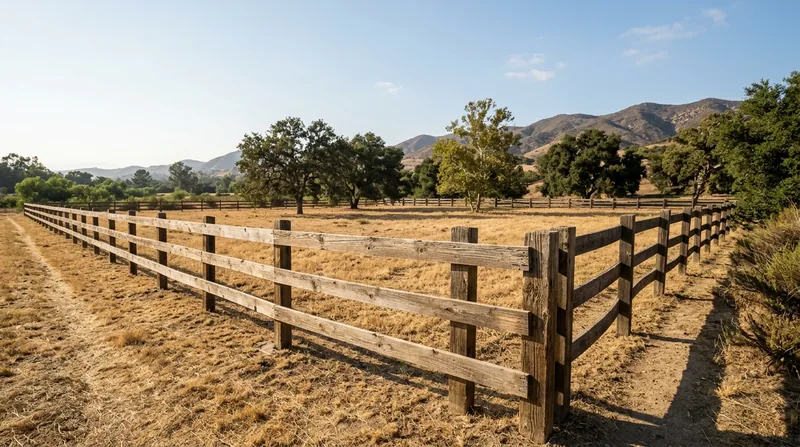




Anaheim stretches across flat sandy alluvial plains dotted with 1950s-60s tract ranches and rolling Anaheim Hills terrain where newer two-story homes climb the canyons. Properties here range from tight urban lots on narrow streets to acreage parcels in Yorba Linda, Villa Park, and Orange Park Acres where horses, small livestock, and equipment demand serious perimeter fencing. Farm fence installation in Anaheim and the surrounding canyon communities calls for straight lines over long runs, heavy-duty materials that resist UV and moisture, properly braced corners, and gates sized for trailers and farm vehicles. Santa Ana winds in fall and winter stress fence panels and topple trees; intense summer sun grays and splits wood; daily sprinkler spray rots posts at the ground line; and the rare winter downpour softens hillside clay. We install ranch rail, no-climb horse fence, field wire, and pipe fencing that holds up to the climate and the work. Get a free estimate at (657) 207-8168.
Why Ranch & Farm Fencing Matters in Anaheim Hill Communities
Acreage and equestrian properties in Yorba Linda, Orange Park Acres, and the canyon communities around Anaheim demand fencing that goes beyond privacy or security. A horse or livestock fence must contain animals safely, resist daily wear from hooves and horns, handle wind and weather without sagging or collapsing, and stay functional through years of gate cycles and equipment traffic. Standard residential fencing fails this duty. Ranch rail, field wire, and pipe fencing are engineered for the job, with deeper post holes, concrete footings, braced corners, and heavier gauge materials that hold up to equestrian and agricultural use across Orange County's foothills and flats.
- Install ranch rail fencing in 2-rail or 3-rail configurations with pressure-treated or cedar posts set deep in concrete for long-term stability.
- Use no-climb horse fence (field wire) with 2x4-inch openings to prevent hooves and horns from catching, reducing injury risk to animals.
- Run pipe fencing for high-traffic areas and gates where steel durability and low maintenance outweigh the cost of wood.
- Install braced corners and anti-sag bracing on long runs to resist wind load and prevent panel flex over time.
- Size and hang gates for trailers, equipment, and vehicles, with self-closing self-latching hardware where codes require it.
These methods keep animals secure, resist Orange County's climate, and hold their value for decades.
Key info: Acreage lots in Yorba Linda, Villa Park, and Orange Park Acres often sit on expansive clay hillsides where winter rains soften soil. Posts must be set deeper and on concrete piers rather than tamped earth alone to prevent settling and sagging as the seasons change.
For detailed guidance on equestrian fencing, see our gate installation and repair page, which covers the hardware and sizing needed for working gates on acreage.
How We Install Ranch & Farm Fencing in Anaheim
Farm fencing over long runs and hilly terrain requires a methodical approach. We start with a site walk to identify grade changes, soil conditions, tree locations, and the utility lines that run underground. California law requires a free utility locate (811 call) before any post holes go in, and we order that immediately. We then stake the fence line, set posts at the correct depth and spacing (typically 6 to 8 feet apart for ranch rail, closer for field wire to prevent sagging), and brace corners and long spans to handle wind load. Finally, we hang rails or wire, install gates, and test every latch and hinge before we leave the site.
- Walk the property, identify grade, soil type, utilities, and obstacles to plan post locations and material quantities.
- Call 811 for a free utility locate and wait for the locate marks before digging any post holes.
- Dig post holes at the correct depth (typically 3 feet for ranch rail on level ground, deeper in clay or on slopes) and set posts in concrete footings.
- Install rails, wire, or pipe, working around grade changes with stepped or racked installation as the slope requires.
- Brace corners and long runs with diagonal bracing or tension bands to resist wind and prevent sagging.
- Hang gates on hinges and install latches, self-closers, or automatic operators as the job scope requires.
- Walk the line, test every gate, and document the work for your records.
This process takes 3 to 7 days depending on property size, terrain, and the number of gates.
Example: A 5-acre Yorba Linda property with a 3-rail horse fence around the perimeter, a 12-foot double gate for trailers, and stepped installation up a canyon slope typically runs 1,200 to 1,400 linear feet. We set 150 to 180 posts on 8-foot spacing, brace the high corners, and hang the gate with self-closing hardware. The job takes 5 to 7 working days and holds its line for 15 to 20 years with routine maintenance.
Learn more about fence replacement and removal if an old ranch fence needs to come down first.
Ranch & Farm Fencing Methods and Materials
| Approach | Description | Best for |
|---|---|---|
| Ranch Rail | 2-rail or 3-rail horizontal rails on pressure-treated or cedar posts set in concrete. Classic and durable for equestrian properties. | Horse and livestock containment, aesthetic appeal, long-term durability on acreage. |
| No-Climb Horse Fence | Field wire with 2x4-inch mesh openings stapled or welded to wooden posts or metal frames. Prevents hooves and horns from catching. | Equestrian safety, paddocks, small pastures where injury prevention is critical. |
| Pipe Fencing | Galvanized or powder-coated steel pipe welded or bolted to posts. Low maintenance, high durability, industrial appearance. | High-traffic gates, equipment areas, long-term low-maintenance installations on large properties. |
| Split Rail with Field Wire | Rustic split rails topped with field wire for a traditional look with modern containment. Posts set in concrete on long runs. | Aesthetic horse fencing, mixed-use properties, areas where appearance and function both matter. |
| Barbed Wire | Galvanized barbed wire on wooden posts for livestock containment. Low cost, requires routine inspection and maintenance. | Cattle, sheep, and goat containment on rural properties where horses or close animal contact is not the primary concern. |
Each method has a place. Ranch rail looks best and lasts longest but costs more upfront. No-climb horse fence balances safety and cost. Pipe fencing demands the least maintenance. We help you choose based on animal type, budget, terrain, and long-term plans for the property.
Farm & Ranch Fencing Cost in Anaheim: What to Expect
Ranch and farm fencing in Anaheim and the surrounding acreage communities starts at $12 per linear foot for basic ranch rail on level ground with easy access. Costs rise with terrain, soil type, material choice, and gate complexity. A 3-rail horse fence on gentle slopes runs $14 to $18 per foot. Pipe fencing costs $16 to $24 per foot because of material and welding labor. Field wire with wooden posts runs $8 to $12 per foot, making it the most economical choice for large perimeters. Gates add $800 to $3,500 each depending on width and automation.
Factors that move the price up include stepped or racked installation on hillsides (common in Yorba Linda and the canyon communities), rocky or clay soil that slows digging, existing trees or structures close to the fence line, and long runs without vehicle access that require hand-carrying materials. A property on expansive clay in the Anaheim Hills may need deeper post holes and concrete piers, adding cost but ensuring the fence stays level through winter rains and summer drying cycles.
Get two or three estimates before committing. Each contractor will read the site differently, and the spread often reveals hidden costs or shortcuts. Ask what's included at the quoted price: does it cover the 811 locate, concrete for post footings, gate hardware, or site cleanup? A real estimate also names the material grade (pressure-treated versus cedar, galvanized versus powder-coated) so you know what you are paying for. See our full pricing page for more detail on what moves the needle.
Farm & Ranch Fencing Near Me: What Anaheim Homeowners Should Know When Hiring a Contractor
Hiring a fence contractor for acreage and equestrian work is a bigger commitment than a residential privacy fence. The job runs longer, costs more, and the quality of the work directly affects animal safety and property value. Start by checking that the contractor carries general liability and workers' compensation insurance and can provide a certificate of insurance on request. In California, fence work requires a C-13 Fencing Contractor license once a project reaches $1,000 in combined labor and materials or requires a building permit.
Ask for references from recent farm and ranch fencing jobs, ideally on acreage similar to yours. Call those customers and ask how the fence has held up, whether the contractor finished on time and on budget, and whether the gates work smoothly. Check whether your property or HOA has deed restrictions or architectural standards that govern fence height, material, or color; if you are in a master-planned community like some areas of Anaheim Hills, those rules often override what you think you want. Finally, confirm that the contractor will call 811 for a free utility locate before digging and will obtain any permits your city or county requires. Permits are required in some jurisdictions and not others; your local building department will tell you.
Call Anaheim Fence at (657) 207-8168 for a free estimate. We walk your property, identify the constraints, explain the options, and give you a clear price before we start work.
Farm & Ranch Fencing in Anaheim: Pricing Guide
| Service | Price | Details |
|---|---|---|
| Ranch rail (2-rail or 3-rail) | Starting at $12/ft | Posts set in concrete on 8-ft spacing, pressure-treated or cedar, level ground with vehicle access |
| No-climb horse fence with field wire | Starting at $8/ft | Field wire stapled to wooden posts, 2x4-inch mesh, ideal for paddocks and large perimeters on acreage |
| Pipe fencing (galvanized or powder-coated) | Starting at $16/ft | Steel pipe welded to posts, low maintenance, high durability, best for high-traffic gates and long-term installations |
| Stepped or racked installation on slopes | Add $2-$4/ft | Terrain in Yorba Linda and canyon communities requires stepped posts to follow grade, increasing labor and material |
| Gates (single or double, 8-12 feet) | $800-$3,500 each | Hardware, hinges, latches, and self-closing mechanisms; double gates for trailers run higher than single gates |
| Free estimate and 811 utility locate | Included | Response within 24 hours at (657) 207-8168, no obligation, utility locate ordered at no charge before digging |
Indicative pricing, the exact cost depends on square footage, finish, and site access. Free personalized estimate within 24h at (657) 207-8168.


